
Plain-language guide to pressing shapes, triggers and risk: how coaches decide between hunting the ball and dropping into a compact defensive block. Pressing is the tactical bet that defines modern football.
The pressing calculus
Pressing is a wager on time and space. You trade ground and energy for the chance to win possession high up the pitch. The payoff is greatest when the opponent is vulnerable: a poor first touch, a defender facing his own goal, or an isolated receiver.
If the press fails, the reward collapses into risk: big spaces behind your line and a scramble to recover. The best teams treat pressing as choreographed risk, training a few clear triggers and rehearsing the cover if the press is bypassed.
Press with a plan, not just with passion.
Modern sides also rely on counter-pressing: the moment they lose the ball, the nearest player jumps to the ball while others close passing lanes. Liverpool under Jürgen Klopp and teams coached by Pep Guardiola have turned that five-second window after losing possession into a primary attacking weapon.
Pressing triggers — the short list
Triggers are instant cues that tell the team to jump. Drill a small number of universal triggers so reactions become automatic:
- Poor or heavy first touch by an opponent.
- Back-pass to the goalkeeper or a centre-back receiving with back to play.
- Pass into a weaker foot or a player isolated on the sideline.
- Defender out of position, such as a centre-back dropped alone or a full-back pushed too high.
- Goalkeeper receiving under pressure or with poor body orientation.
- Slow or sideways play in the attacking half.
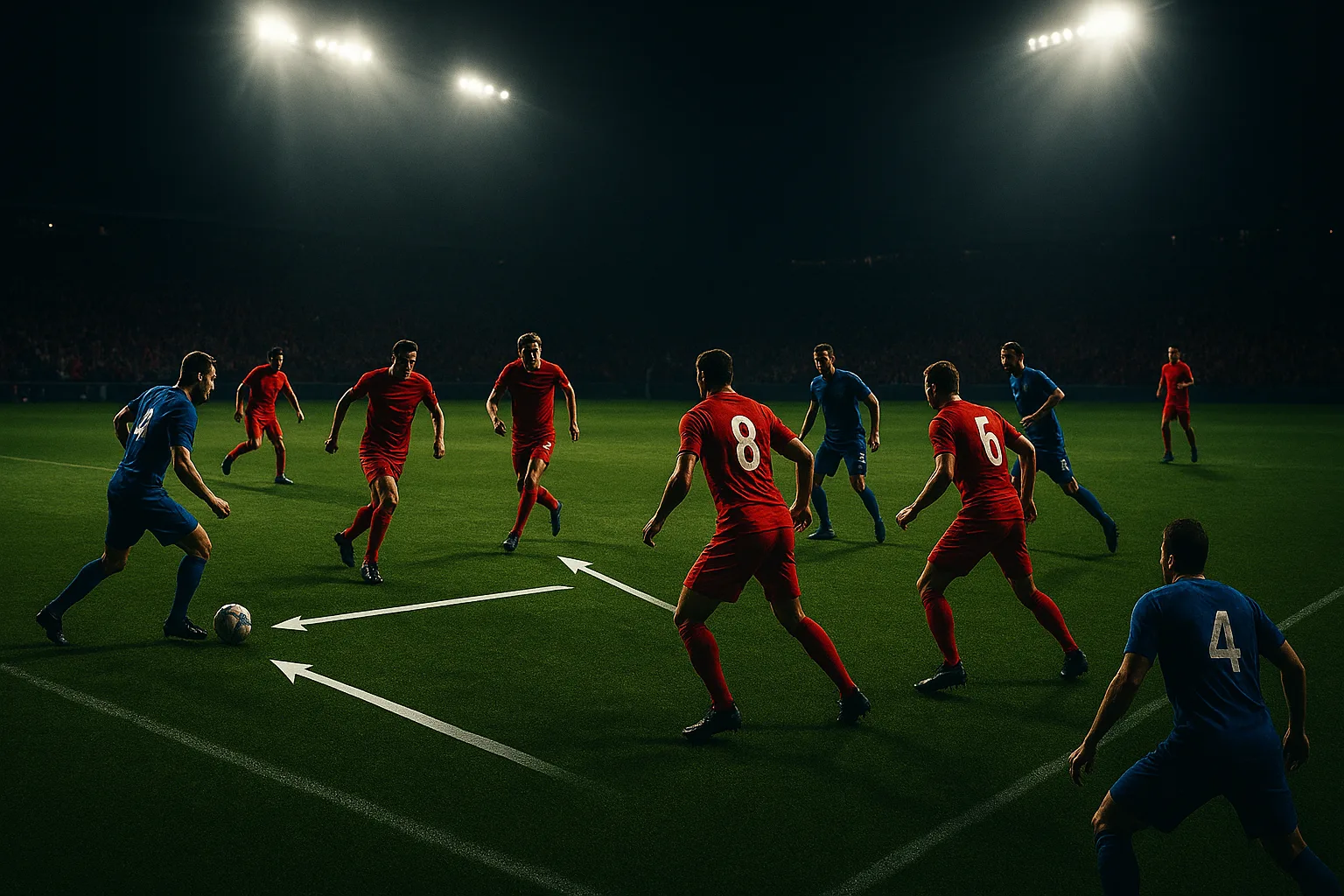
When a trigger fires, the nearest two or three players must act immediately. One pressures the ball; the others cut likely outlets. This pressing triangle limits easy escape passes and keeps the first presser from being played around.
Pressing shapes and examples
Which shape you use changes what passes you cut off and where you accept risk.
High press (hunt)
The team pushes into the opponent's defensive third. Forwards and midfielders compress passing lanes to force mistakes near goal.
When it works: against teams that build from the back, when you need an early goal, or when your forwards are quick and ruthless in transitions. Klopp's Liverpool popularised a ruthless high press that aims to win the ball back within seconds of losing it.
Downside: a missed challenge or a long pass over the top leaves dangerous space behind and can send a striker through on goal.
Mid-block
The team lives in the middle third, inviting the ball into a predictable zone and pressuring transitional passes. It balances aggression and caution and often appears as a compact 4-4-2 or 4-3-3 mid-block.
When it works: to take away central progression and force the opponent to play wider or attempt riskier switches. Diego Simeone's Atlético Madrid have long used a disciplined 4-4-2 mid-block to suffocate space between the lines.
Downside: you concede some possession and must be organised to prevent line-breaking balls into the pockets between midfield and defence.
Low block (drop)
The team sits deep and narrow around the penalty area, denying space between lines and forcing the opponent to break you down slowly.
When it works: to protect a lead, against rapid counters, when you're tired, or when pitch conditions encourage direct play.
Downside: you cede territory and momentum and must defend with concentration while staying sharp on set pieces.
Special approaches
- Man-to-man pressing: Marcelo Bielsa's teams are the extreme example, assigning each player an opponent to follow. It can suffocate opponents but demands elite fitness and discipline.
- The trap: some teams deliberately leave one passing lane open to bait the opponent into playing there. Once the ball enters the trap, two or three players converge to win it back.
Managing the risks — practical steps
Good teams reduce downside with numbers, distance and recovery:
- Stagger lines so midfielders tuck behind forwards and protect channels if the press is bypassed.
- Use cover shadowing, with a defensive midfielder or full-back positioned to protect vacated zones.
- Keep compactness, with narrow distances between lines so a single pass cannot split you easily.
- Set fallback triggers: if the press fails after a set time, such as five seconds, reset into a mid-block.
- Trust a sweeping goalkeeper who is ready to attack long balls behind a high line.
- Manage fitness by alternating intense pressing phases with calmer possession and rest periods.
Simple decision rules coaches can use
Remove hesitation with pre-agreed rules that players can follow without thinking:
- Scoreline and time: if leading and under 15 minutes to go, default to dropping into a deeper block unless a clear trigger appears.
- Possession threshold: if the opponent completes a series of passes in build-up without pressure, shift from high press to mid-block.
- Personnel rule: if your most mobile forward is off the pitch, reduce high pressing frequency.
- Risk cap: avoid pressing aggressively if more than two opponents are already beyond your defensive line.
These kinds of rules turn a subjective call into an automatic team response.
In-game signals and communication
Fast, recognisable cues matter more than long instructions.
- Vocal cue: the nearest midfielder shouts a clear call like "press" or "drop" on the trigger.
- Bench signal: a raised arm or short whistle from staff to indicate "step up" or "hold the line".
- Non-verbal: body orientation, eye contact and a shared step forward can start a collective move.
Train these cues until they are reflexive, so the whole unit jumps or drops together.
Small tactical tweaks that make pressing safer
- Recruit a defensive midfielder who reads passes and buys recovery time after a broken press.
- Use full-backs with speed who can recover quickly to cover wide counters.
- Practice transitions from press to compact block, with a clear target for how quickly the shape must reset.
- Prepare set-piece and transition protocols; many goals against come from losing the ball near your own box.
These tweaks do not change your identity, but they quietly raise the safety floor of an aggressive press.
How coaches decide in real time
Coaches juggle score, energy, opponent profile and game shape:
- Score: teams chasing the game press higher; teams protecting a lead drop deeper.
- Energy: visible fatigue in the second half often forces a more cautious line.
- Opponent passing: if the opponent is comfortable under pressure, pressing is less effective and may need to be scaled back.
- Game shape: repeated long balls over the top usually demand a deeper, more compact block.
Most matches never stay purely one way. Good sides mix phases of high pressing, mid-block control and low block protection, changing their mind before the opponent can exploit the gaps.
A short checklist for coaches and fans
- Drill three to five pressing triggers until reactions are instinctive.
- Agree a couple of simple in-game rules, based on scoreline, time and key personnel.
- Rehearse recovery: every pressing plan needs a plan B.
- Make players responsible for a small area and a short list of cues.
Pressing and dropping are two faces of a single strategy. Press when the odds — numbers, proximity, opponent vulnerability — are in your favour. Drop when the pass behind your line is likelier to hurt you than the immediate reward is worth. Simplicity wins: teach the cues, rehearse the recovery, and let players act decisively.