
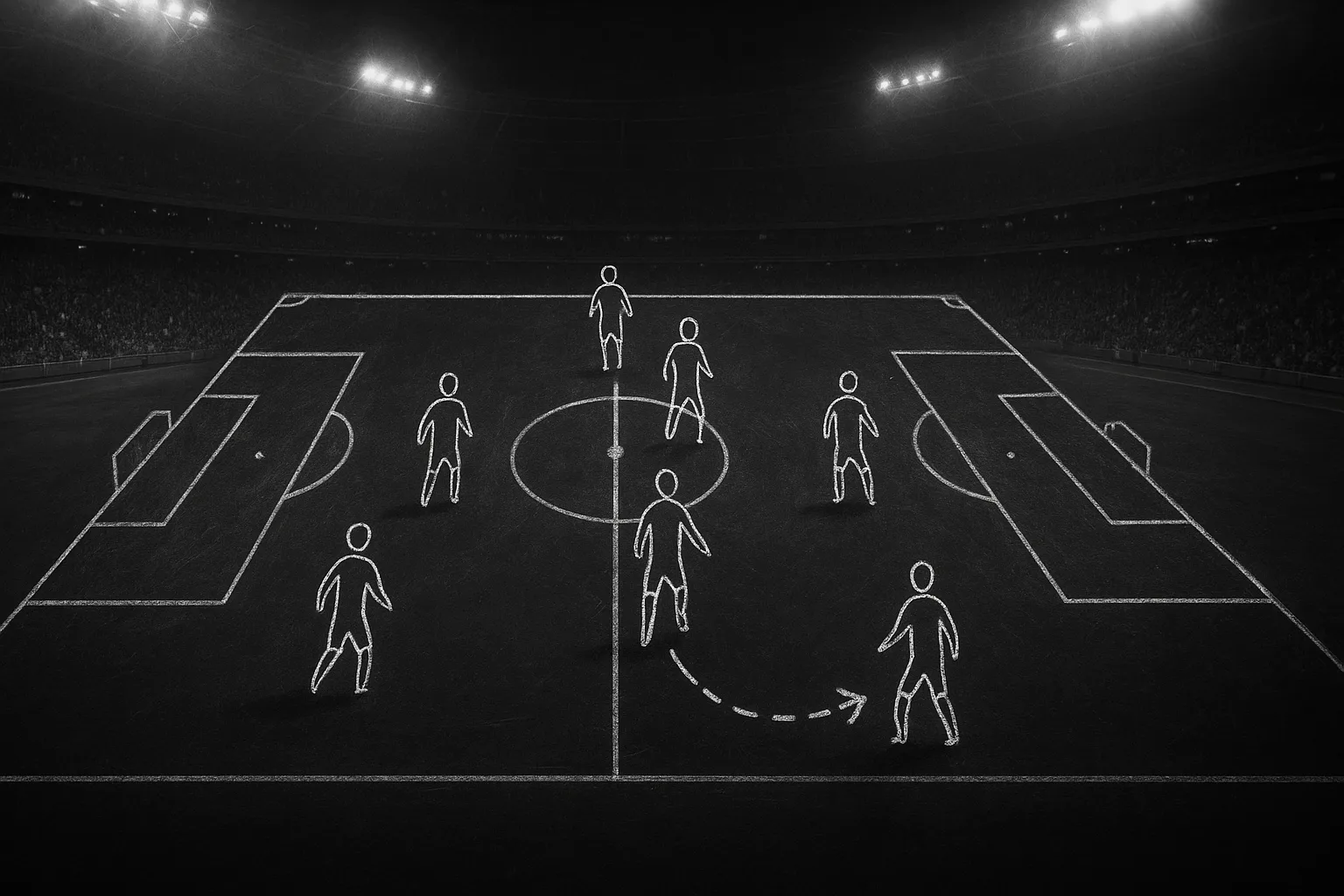
On 25 November 1953, Hungary beat England 6–3 at Wembley with a centre-forward who rarely behaved like one. Nándor Hidegkuti spent long spells between England’s midfield and defence, drew Harry Johnston out of position and opened lanes for Ferenc Puskás and Sándor Kocsis. His hat-trick in England’s first home defeat to non‑British opposition turned a clever tweak into a global talking point.
The idea would drift in and out of fashion, resurface in the Netherlands, and then redefine elite football through Lionel Messi, Roberto Firmino and a generation of forwards who refuse to stand still. Today the false nine is no longer a curiosity. It is a core attacking shape that forces defenders to choose between space and pressure.
A pre‑war thread and Hungary’s blueprint
The story starts before Wembley. In the early 1930s Austria’s Wunderteam, built by Hugo Meisl around Matthias Sindelar, used a fluid front line with no fixed spearhead. Sindelar often dropped towards the ball, pulled markers away from their line and released runners from wide and midfield. Austria’s run to the 1934 World Cup semi‑finals showed that a centre‑forward could be a creator, not just a finisher.
After the war, the WM formation locked teams into rigid roles. The number nine stayed high, occupied the centre‑half and attacked crosses. Creativity came from inside forwards, not the striker. A roaming centre‑forward was treated as a positional mistake.
Gusztáv Sebes’ Hungary broke that logic. Sebes moved Hidegkuti from his usual inside‑forward role into the centre, but with a different brief: start high, then receive between England’s lines. When Johnston tracked him, Hungary’s runners charged into the empty space; when Johnston held his position, Hidegkuti turned and played. The 6–3 at Wembley and the 7–1 return in Budapest were results built on that repeated dilemma.
Cruyff and Total Football: the idea becomes a system
In the 1970s Johan Cruyff and Rinus Michels turned the withdrawn striker from a single ploy into a full framework. At Ajax and with the Netherlands, Cruyff was nominally the centre‑forward, but Total Football treated his starting spot as only a reference point. He would drift to the wing, into midfield or even back towards his own defence, and a teammate would flow into the space he left.
At the 1974 World Cup, that movement pulled opponents apart. Against Argentina, Cruyff spent long stretches almost as a midfielder, leaving central defenders with nobody to mark and too many runners to track. The false nine stopped being a trick played by one man and became a shared duty in a rotating front line.
Spalletti and Totti: the modern bridge
The role re‑entered mainstream club coaching in the mid‑2000s. At Roma in 2006–07, Luciano Spalletti shifted Francesco Totti from a classic number ten into a central, withdrawing forward. Totti would drop into midfield to receive and combine, while wide players and midfield runners attacked the space inside the box.
That adjustment did more than freshen Roma’s attack. Totti scored 26 league goals and won the European Golden Shoe, proving that a false nine could still post striker numbers while shaping the team’s build‑up. Coaches took notice: the deep‑lying centre‑forward was suddenly a viable core plan, not an exotic experiment.
Messi and Guardiola: the global template
Pep Guardiola’s Barcelona turned the false nine into a global reference. From 2009 he used Lionel Messi centrally in a 4‑3‑3, asking him to drop off the line, receive between the lines and drive at unsettled centre‑backs. In the 2009 Champions League final against Manchester United, Messi started in the middle with Samuel Eto’o and Thierry Henry wide. When he drifted into midfield, defenders faced an unpleasant choice: step out and leave the box exposed, or hold their line and allow him time to turn.
Barcelona’s structure made that choice even harder. When Messi dropped, Xavi and Andrés Iniesta pushed into advanced pockets, full‑backs stepped high, and wide forwards ran beyond. The false nine became the hub of a passing carousel rather than a lone maverick. Between 2009 and 2012 that pattern produced some of the most controlled attacking football the club has ever played.
Spain transported the idea directly into international football. At Euro 2012, Vicente del Bosque started Cesc Fàbregas, a midfielder by trade, as a false nine in the final against Italy. Spain packed midfield with passers, used wide players to stretch the defence and beat Italy 4–0 without a traditional striker on the pitch.
Firmino and the pressing false nine
Jürgen Klopp’s Liverpool added another layer: the false nine as a defensive trigger. Between roughly 2015 and 2020, Roberto Firmino was the central forward but rarely the pure goalscorer. His job was to link with Mohamed Salah and Sadio Mané, overload midfield and set off Liverpool’s press.
Firmino would drop into the pocket to help build attacks, then jump towards the centre‑backs the moment possession was lost. His movement compressed the team, kept passing lanes blocked and allowed Liverpool to win the ball close to goal. In the Champions League and Premier League‑winning seasons, his value out of possession was as obvious to coaches as his clever touches in the final third.
Defending from the front is now baked into the role. A false nine who wanders around without clear pressing triggers leaves the midfield exposed. A forward who understands when to jump, when to screen and when to delay can anchor the entire structure. For a deeper look at those choices, Pressing 101: When to Press and When to Drop breaks down how that first line works.
A false nine’s job is not to be invisible in attack; it’s to make the opposition’s structure visible and exploitable.
What the false nine actually does
Strip the history away and the role is simple: a nominal striker who abandons the penalty area to play between the lines. That decision has knock‑on effects everywhere else.
First, it pulls central defenders out of their line. When a centre‑back steps into midfield to follow, the channel between him and his partner opens for wide forwards or late‑arriving midfielders. If he stays, the false nine receives with time to turn, pass or shoot.
Second, it links midfield and attack. Instead of a fixed target for crosses, the team gains an extra passing option in the most congested zone. The false nine becomes a connector who can bounce passes, slide runners through and reset possession rather than waiting for service.
Third, it bends pressing patterns. With the central forward dropping, the team can press from a slightly deeper line, clogging the middle instead of chasing high long balls. That flexibility lets coaches tailor their first line of pressure to the opponent’s build‑up style.
Trade‑offs and recruitment
The false nine is powerful, but it is not a universal solution.
It naturally reduces guaranteed presence in the box. If the striker keeps drifting away from goal, someone else has to arrive in the area on cue: wide forwards cutting inside, number eights timing late runs, or full‑backs attacking the back post. Teams without those coordinated movements end up dominating the middle but staring at an empty penalty spot.
The role also demands technique and game intelligence. The false nine has to control awkward balls, play with his back to goal, and judge when to turn, recycle or release a runner. Many traditional strikers are uncomfortable with those tasks; forcing them into the role can flatten an attack.
Defensively, a disciplined, narrow block can suffocate the spaces the false nine wants, and a centre‑back who is happy to follow relentlessly can blunt his influence. Those realities shape how clubs recruit. Sporting directors now weigh progressive passing, pressing output and spatial awareness alongside finishing when they choose forwards.
What to watch next
The false nine changed how coaches talk about forwards. Instead of a simple split between target men and poachers, elite teams now look for hybrids: players who can arrive in the box, drop into midfield, connect play and lead the press.
That shift is already visible in top leagues, where forwards switch between acting as a classic nine and a temporary playmaker depending on phase and opponent. The next step is likely to be even more fluid lines, with entire front threes sharing false‑nine duties rather than one designated specialist.
Hidegkuti’s afternoon at Wembley suggested that absence can be just as dangerous as presence. The role’s legacy is a more subtle one: it taught modern football that pulling away from the spotlight can be the most direct route to goal.