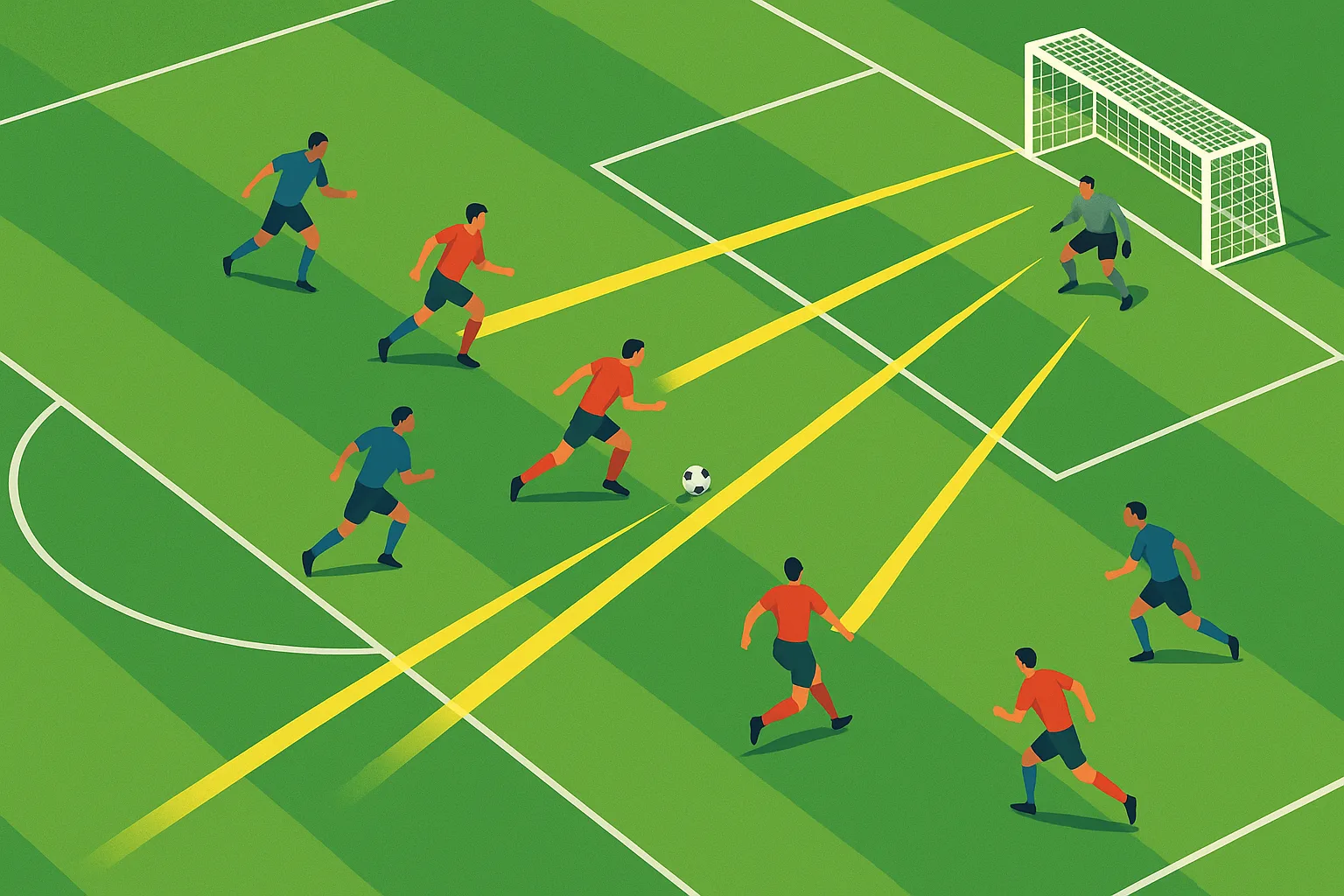
Zonal marking guards space, man marking tracks opponents. Top coaches mix them across corners, free kicks and open play to balance duels, cover and structure.
When Vinícius Júnior slipped in behind Liverpool’s defence to score the 2022 Champions League final winner, it wasn’t a complex play. One runner arrived free at the back post in a crowded box, exposing the thin line between guarding zones and tracking men. That moment is the essence of the debate: do you defend the dangerous space, or the dangerous player?
The two systems in plain terms
Man marking gives each defender a specific opponent to follow. Wherever that attacker goes, the defender goes. The logic is straightforward: every attacker has a shadow, and nobody should be left unchallenged in front of goal.
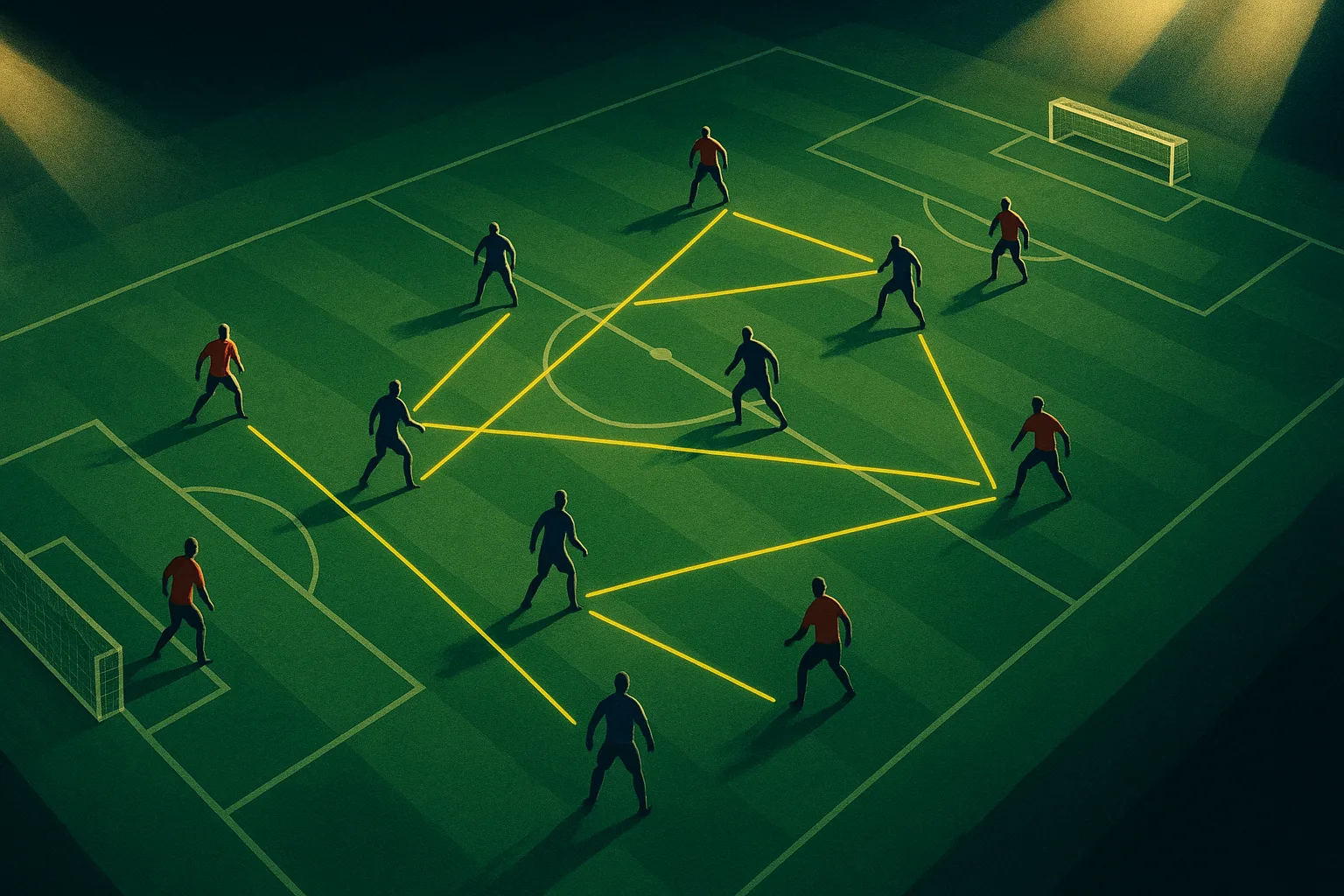
Zonal marking assigns each defender an area instead. A player guards the space around the six-yard box, the penalty spot or the near post, and deals with whichever opponent enters that territory. The key question changes from “who am I marking?” to “what happens in my area?”
Both ideas are old and deeply embedded. For decades, man marking dominated in England and Italy, creating tight personal duels and centre-backs whose identity was built around beating their man. Zonal thinking spread as coaches dissected set-piece footage and saw how often decoy runs and blocks dragged markers away from the real danger.
Set pieces: where the trade-off is sharpest
Corners and wide free kicks compress the game into a small space with predictable delivery angles. That makes the choice between zonal and man marking brutally clear.
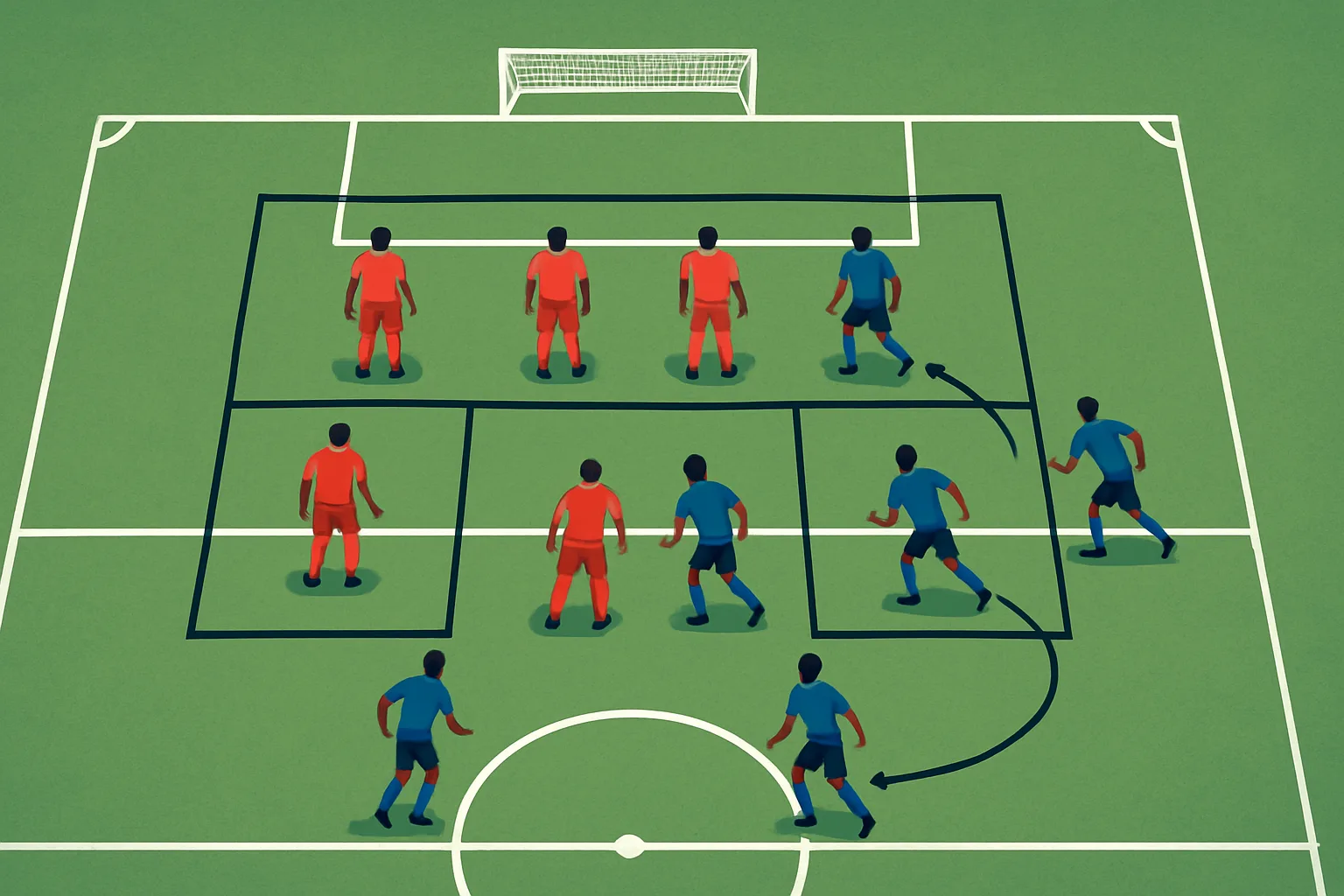
In a corner, man marking’s strength is responsibility. Each defender knows exactly who they are up against, and a dominant header shadowed closely is harder to free. The weakness is the screen. Attackers routinely send one player to block a defender’s path at the near post; as the marker fights through traffic, his man drifts into space for a clean jump.
Zonal marking handles screens better because nobody is chasing a particular runner through the crowd. Defenders stay in their zones, face the ball and attack it. The vulnerability is the seam between zones, where two players hesitate, each assuming the other will take the attacker or the ball. Smart set-piece routines are designed to hit those gaps.
Most modern teams settle on hybrids. A common pattern on corners is a “zonal spine with man markers around it”: several players occupy key zones along the six-yard line and penalty spot, while others track the most dangerous aerial threats. Free kicks from wide areas often use the same logic, with a core of zonal defenders protecting goal and a few specialists matched to specific targets.
Every corner is a contract. The question is who has signed up to what.
That’s how set-piece coaches talk to players. The scheme only works if everyone knows whether they’ve agreed to own a space or own a man.
Open play: shape versus control
In open play, most teams lean toward zonal principles. A back four or five holds a compact shape, shifting together as the ball moves. Midfield lines compress central space, forcing opponents into wider, less efficient routes to goal. The classic low block described in The Low Block: How Defensive Solidity Wins Trophies is zonal at heart: distances are measured, lanes are closed, and the unit moves as one.
The trade-off is initiative. Purely zonal teams can become reactive, waiting for the ball to come into their area instead of disrupting the pass before it arrives. That’s why many coaches combine zonal structures with man-oriented pressing triggers, like those outlined in Pressing 101: When to Press and When to Drop. The team holds its shape, but when a specific opponent receives between the lines, someone is allowed to step out aggressively.
Man marking in open play flips the priorities. Assigning direct opponents all over the pitch can suffocate a technically superior side, as seen in several man-to-man pressing teams in recent years. Done well, it denies creative players the time and angles they need. Done poorly, it tears the defensive shape apart as markers get dragged into wide or deep areas.
The core open-play dilemma is structural. Every time a defender follows his man into an unusual position, someone else must cover the space he has left. The more man-oriented the scheme, the more the team depends on seamless role swaps and communication.
How coaches build hybrids
At high level, very few sides are purely zonal or purely man-oriented for ninety minutes. Coaches mix elements to suit their squad, the opponent and the game state.
One common pattern is “zonal base, man-oriented pressure”. Players start in a compact shape. When a predefined opponent receives the ball in a dangerous pocket, the nearest defender jumps out to engage, while teammates slide over to plug the gap. From the touchline, it still looks zonal, but inside the structure there are clear man-marking triggers.
Another pattern pairs a man-marking centre-back with a more zonal partner. The marker follows a key striker into the channels or between lines; the partner focuses on guarding the space that opens up behind or alongside that duel. That approach only works with constant communication, because one mistimed movement from either defender can expose the box.
Scoreline and substitutions push coaches to adjust the blend. Protecting a narrow lead with a tired team usually nudges managers toward firmer zonal shapes and deeper lines, prioritising compactness over chasing runners. Introducing a tall defender in the final minutes may tilt set-piece plans toward extra man marking on the opposition’s best header, while leaving the basic zonal structure intact.
Coaching the details: making hybrids reliable
The theory is simple; the execution is not. The difference between a neat diagram and a working hybrid system lies in the small coaching decisions.
- Designate an organiser. One voice, usually a centre-back or goalkeeper, must own the defensive organisation on set pieces and call switches clearly.
- Define the spine. Fix default zonal spots such as near post, central six-yard area, penalty spot and edge of the box. Those areas rarely change, even if the opponent’s routine does.
- Identify outliers. Before kick-off, decide which two or three opposition players warrant personal markers and who takes them. Everyone else knows they are primarily guarding space.
- Practice hand-offs and chaos. Training needs messy drills: flick-ons, short corners, blocks, deflected crosses and second balls. Players have to rehearse who attacks the ball, who tracks the runner and who stays in the safety zones when the first contact is lost.
- Adjust to personnel. A back line full of strong headers can afford more man-marking at set pieces. A lighter, more mobile defence may lean into zonal cover and collective movement.
What coaches should really ask
The debate is rarely “zonal versus man” in a vacuum. The sharper questions are practical. Which spaces does this opponent want to exploit? Which players do they depend on to attack those spaces? Do your defenders communicate well enough to trade roles mid-action without panic?
Zonal marking shapes the geometry of danger. Man marking isolates individual threats. The best teams treat them as tools, not dogmas, layering zones for cover and assigning markers where duels decide the outcome. Next time a corner flies in, watch the defenders’ eyes: those fixed on the ball are guarding space, those locked onto a runner are marking a man. Whether they’re working together is what decides the goal.